Coffee Doesn’t Ask Silly Questions: Graphics for Crafts & Branding
As a graphic designer who’s built brand identities for over a dozen handmade businesses—from ceramic studios to local coffee roasters—I recently evaluated Coffee Doesn’t Ask Silly Questions for a client launching a spring “Slow Mornings” collection of mugs, tote bags, and printable wall art. My goal wasn’t just to see if it looked cute—it was to assess whether this design asset could carry real weight in a commercial context: reinforcing tone, supporting visual hierarchy, and scaling across physical and digital touchpoints without losing charm or clarity.
A First Impression That Lands With Warmth, Not Gimmicks
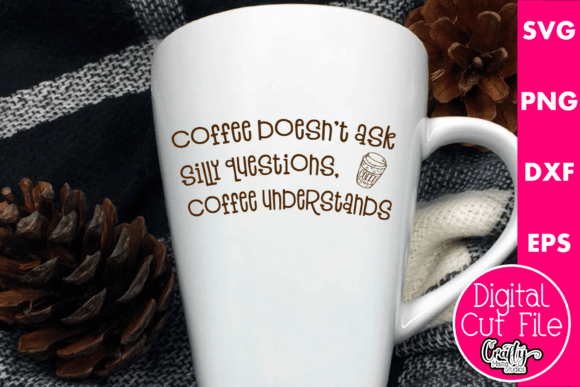
Opening the file bundle, I immediately noticed how Coffee Doesn’t Ask Silly Questions avoids the trap of over-the-top cartoonishness common in generic coffee clipart. The typography leans into friendly, slightly rounded sans serif with subtle personality—neither sterile nor chaotic. There’s no forced distressing or excessive shadowing. It feels like a well-edited illustration: confident, conversational, and quietly confident. That balance makes it ideal for brands that want warmth without sacrificing polish—think small-batch bakeries, wellness journals, indie stationery lines, or Etsy shops selling morning ritual kits.
Where This Graphic Design Asset Earns Its Place in Real Projects
In my client’s packaging design, I placed Coffee Doesn’t Ask Silly Questions as a secondary brand element on the back of a kraft paper mug sleeve. It worked beautifully—not as a logo replacement, but as an emotional anchor. On product mockups, it added instant relatability to social media graphics and Pinterest pins. For their Canva template suite, I embedded the SVG version into editable layouts so customers could swap colors while preserving clean vector edges. As a Cricut project base, the DXF and SVG files cut precisely on cardstock and vinyl—no jagged edges or misaligned layers.
It shines brightest in:
- Hero graphics for landing pages or email headers—especially when paired with soft neutral photography;
- Product labels and stickers, where its bold letterforms hold up at 2–3 inches wide;
- Printable designs like quote cards or café-themed planners—its PNG version includes crisp transparency for seamless layering;
- Merchandise including sublimation mugs and cotton totes, where the EPS ensures smooth color fills under heat press;
- Themed campaign visuals, like a “Fuel Your Focus” series for a productivity planner brand.
Where to Use It With Intention—Not Assumption
This isn’t a one-size-fits-all logo replacement. At under 16px, the text begins to blur in UI contexts; it doesn’t function well in app icons or tiny favicon sizes. In minimalist branding systems—say, a high-end skincare line using strict Helvetica Neue—Coffee Doesn’t Ask Silly Questions would feel tonally dissonant. It also struggles on busy, textured backgrounds (like linen overlays or watercolor scans) unless given generous negative space or a subtle drop shadow. And while it reads clearly on light and dark modes individually, rapid A/B testing revealed reduced visual trust when placed directly over low-contrast gradients—so always preview on actual background swatches before finalizing.
Design Judgment Calls You Can’t Skip
Before clearing Coffee Doesn’t Ask Silly Questions for client use, I ran these checks:
- Tested black-and-white output: Confirmed legibility in monochrome print—no thin strokes vanish, no spacing collapses;
- Checked SVG editability: Verified all paths are ungrouped and editable in Illustrator (no embedded raster elements);
- Compared font pairings: Works best with clean sans serifs (Inter, Montserrat) or warm scripts (Pacifico, Qwigley)—not with tight serifs like Bodoni or ultra-minimalist fonts like Manrope;
- Previewed at scale: Zoomed out to 10% to simulate Instagram feed viewing—still readable as a mood cue, not just text;
- Confirmed commercial license scope: Verified the seller grants broad commercial rights—including for print-on-demand, Etsy products, and digital resale in Canva templates—critical for any small business branding project.
Why It Builds Visual Trust—Not Just Visual Noise
What separates Coffee Doesn’t Ask Silly Questions from disposable clipart is its consistency across formats. The SVG, EPS, and DXF versions share identical kerning and weight distribution—meaning your Cricut cut file matches your website graphic pixel-for-pixel. That reliability strengthens brand identity. When used as a supporting element—not the sole voice—it adds emotional resonance without undermining professionalism. For a handmade business trying to stand out in a crowded creative marketplace, that nuance matters: it signals care, not convenience.
A Final Note for Designers & Sellers
If you’re sourcing design assets for client work, remember that Coffee Doesn’t Ask Silly Questions isn’t just a funny coffee quote SVG—it’s a functional piece of marketing visuals infrastructure. It performs across editorial design, web design, packaging design, and social media graphics because it was built with format versatility and commercial intent in mind. But its strength lies in intentionality: use it where warmth, wit, and approachability align with your brand story—and step back where precision, austerity, or formal authority are required. In the right context, it doesn’t just say something about coffee. It says something about your client’s values.