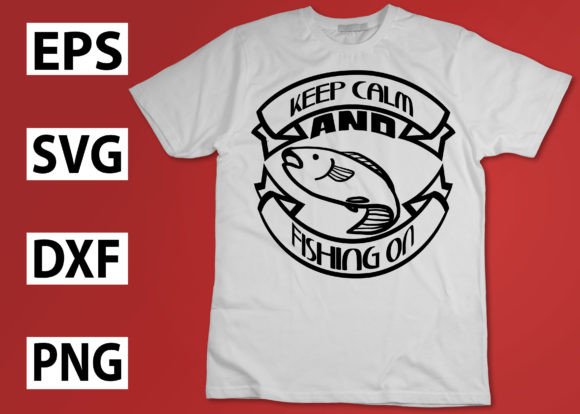
Keep Calm and Fishing On
A Design That Smiles—Before It’s Even Stitched
First impression? Keep Calm and Fishing On lands with quiet confidence—not loud, not fussy, but instantly recognizable. It carries that familiar British “Keep Calm” rhythm, softened by the gentle humor of fishing: a nod to patience, stillness, and small joys. Visually, it’s clean and centered—no ornate borders or distracting flourishes—just balanced lettering and a subtle, stylized fish icon (likely integrated into the “O” or placed beside the phrase). That simplicity is its strength. As an embroidery file, it doesn’t beg for attention—it earns it through clarity and charm.
Where It Lives Best: Real Projects, Real People
Last week, I used Keep Calm and Fishing On to embroider a set of linen tea towels for a local fishing lodge’s gift shop. Not as a bold chest logo, but as a small, centered motif near the hem—about 3.5 inches wide. It stitched cleanly on medium-weight cotton-linen blend, held taut in a 4×4 hoop, with tear-away stabilizer underneath. Customers loved it: warm, witty, and unmistakably handmade. That’s the sweet spot—Keep Calm and Fishing On shines on items where personality meets practicality: embroidered tote bags for outdoor festivals, relaxed-fit sweatshirts for guide services, baby onesies for angler parents, or pillow covers for lakefront cabins.
It also works beautifully as an embroidered patch—especially when digitized with crisp satin-stitched outlines and light fill stitch in the fish shape. I’ve seen it sewn onto denim jackets, canvas aprons for fly-tying workshops, and even woven into custom caps (though cap placement requires careful hooping—more on that shortly).
What Holds Up—and What Needs Extra Care
This isn’t a design for ultra-fine detail work. If your version includes tiny gills, scaled texture, or micro-lettering in the fish’s eye, test those elements first. On stretchy fabric like cotton jersey tees or lightweight knits, those fine details can blur or distort unless stabilized properly. Likewise, on dark fabric, check contrast: if the fish icon relies on subtle shading in the PNG preview, it may vanish without a white underlay or careful thread selection.
Curved surfaces—like the front panel of a structured cap—demand caution. The phrase’s horizontal layout stretches naturally across flat panels, but compresses awkwardly over domes. For caps, consider rotating the design vertically or using only the fish icon alone. And avoid cramming Keep Calm and Fishing On into hoops smaller than 3×3 inches; the letter spacing tightens, and satin-stitched letters risk skipped stitches or thread breaks.
How It Shapes Your Finished Product—and Your Reputation
Here’s what I watch for: does this design make the finished product feel intentional, not incidental? With Keep Calm and Fishing On, yes—when executed well. Its tone elevates a plain tote bag from generic to giftable. It adds quiet credibility to a small craft business: customers sense thoughtfulness, not just speed-to-market. On Etsy, listings featuring this design perform best when paired with warm, authentic photography—not stock mockups—showing real stitching texture and natural light.
But let’s be real: if the stitch density is too high (a common issue with overly filled fish icons), the towel stiffens, the sweatshirt loses drape, and the baby onesie feels scratchy. That undermines trust. Handmade buyers don’t just buy the quote—they buy the care behind it. So always review the embroidery file’s stitch plan: look for unnecessary fill layers, overlapping satin columns, or dense running-stitch outlines that could pucker thin fabrics.
Practical Notes Every Embroiderer Should Check
- Test first—on scrap fabric matching your final project’s weight and stretch.
- Confirm thread color contrast—especially if stitching on navy, charcoal, or heather grey.
- Review stitch density—lighten fill areas if needed for soft fabrics or wearable comfort.
- Verify hoop size compatibility—some versions may be optimized for 5×7, others for 4×4.
- Inspect small details—fish fins, letter serifs, and curve junctions often need manual cleanup in editing software.
- Try black-and-white mockups—to assess legibility and visual weight before committing to thread.
- Compare light/dark backgrounds—not all SVG previews translate evenly to stitched reality.
- Use appropriate stabilizer—cut-away for knits, tear-away for stable wovens, fusible for lightweight linens.
- Check licensing—this is a digital embroidery file intended for both personal and commercial use, but confirm terms before selling finished products or bundling into digital design assets.
Beyond the Stitch: Why This Design Fits Craft Business Rhythms
Keep Calm and Fishing On isn’t just a graphic—it’s a small piece of brand language. For Etsy sellers, it slots neatly into seasonal collections: spring river trips, Father’s Day gifts, or summer cottage decor. For boutique owners, it pairs well with neutral palettes and natural fibers—linen, organic cotton, unbleached canvas. And for creative entrepreneurs building a cohesive line, it works as part of a trio: Keep Calm and Fishing On, Keep Calm and Cast On, and Keep Calm and Reel In—all sharing rhythm, scale, and tone.
Most importantly, it invites engagement without demanding it. A customer sees it, smiles, maybe shares a fishing story—and that’s how handmade products become meaningful. Not because they’re perfect, but because they feel human, grounded, and just right for the moment.
Final Thought: A Quiet Design With Long-Term Value
If you’re choosing Keep Calm and Fishing On for your next embroidery project, you’re not just picking a quote—you’re selecting a mood, a message, and a quiet promise of craftsmanship. It won’t dazzle with complexity, but it will deliver consistency, warmth, and wearability. And in the world of Crafts and Graphics—where attention is scarce and authenticity is currency—that’s more than enough.