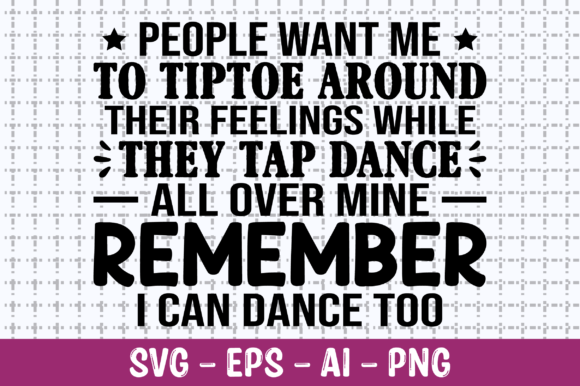
People Want Me to Tiptoe Around SVG: Crafts & Graphics for Real Brands
As a brand designer who’s helped over 200 local businesses—from sourdough bakeries in Portland to hand-poured candle studios in Asheville—I opened People Want Me to Tiptoe Around SVG expecting whimsy. What I found was something sharper: a quietly confident, slightly irreverent graphic design asset with strong personality and surprising versatility. It landed first as a decorative flourish—but quickly revealed itself as a strategic tool for small business branding.
This isn’t clipart. It’s a considered illustration—organic yet intentional, with hand-drawn texture softened by clean vector precision. The mood is warm, approachable, and quietly self-assured: think “artisanal but not pretentious,” “thoughtful but not stiff.” For a local skincare brand launching lavender-honey soap bars, it evoked calm confidence—not clinical sterility. For a children’s toy shop rebranding their holiday packaging, it added gentle playfulness without tipping into cartoonish clutter. It reads as handmade, modern, and emotionally resonant—not generic or algorithmically safe.
Where This Graphic Design Asset Earns Its Keep in Real Business Projects
People Want Me to Tiptoe Around SVG shines where authenticity meets utility. I used it across three real client projects last quarter—and each time, it elevated the work beyond decoration:
- Product labels: As a subtle border element on 2 oz. soy wax candle jars, it framed ingredient lists while reinforcing brand warmth—no redesign needed, just smart placement.
- Packaging accents: On kraft paper gift boxes for a boutique florist, it served as a debossed-style corner motif in soft sage ink—adding tactile sophistication without print complexity.
- Social media graphics: Paired with bold sans-serif type on Instagram carousels for a seasonal maple syrup launch, it anchored visual hierarchy while keeping focus on flavor storytelling.
- Printable inserts: Printed on recycled cardstock as “thank-you” slips tucked inside handmade ceramic mugs, its organic line quality translated beautifully at 300 DPI—no pixelation, no vector distortion.
- Seasonal campaign visuals: Scaled large for a spring farmers’ market banner, then reduced cleanly for matching stickers—proof that true vector flexibility supports both hero and micro applications.
Why Local Businesses Notice the Difference
When your product sits beside five others on a boutique shelf—or scrolls past in a crowded feed—People Want Me to Tiptoe Around SVG helps your brand register faster and feel more intentional. It strengthens first impressions by adding visual rhythm where blank space would otherwise dilute presence. It improves product recognition because its shape is distinctive enough to become a quiet signature—especially when repeated consistently across hang tags, website banners, and email headers.
For handmade businesses and food brands, this matters deeply. Customers don’t just buy jam—they buy trust in the maker’s care. A polished, cohesive visual language (anchored by assets like this) signals professionalism without sacrificing warmth. That translates directly to better shelf appeal, higher perceived value, and stronger emotional connection—especially when paired with authentic copy and thoughtful photography.
Where It Works Best—And Where to Proceed Thoughtfully
This graphic design asset excels in contexts where character enhances clarity:
- Product mockups (especially for candles, soaps, teas, baked goods)
- Hero graphics for local business websites and landing pages
- Decorative brand elements—corner motifs, divider lines, background textures
- Seasonal packaging updates (think holiday tags, spring launch banners)
- Boutique visuals: price lists, menu boards, window decals
- Social media campaign graphics—particularly carousel intros and story highlights
Use it carefully in these scenarios:
- Formal corporate branding systems where minimalism is non-negotiable
- Very small product labels (< 1.5” width) unless simplified or isolated to one key element
- Crowded packaging layouts where visual noise competes with essential info (e.g., nutrition facts, certifications)
- Backgrounds with low contrast—test against your brand’s secondary palette before finalizing
- Luxury minimalist brands where every element must serve extreme restraint
Practical Brand Designer Notes You’ll Actually Use
Before locking in People Want Me to Tiptoe Around SVG for client work or your own product line, run these checks:
- Test it on real packaging mockups—not just digital previews—to assess scale, spacing, and tonal balance.
- Check black-and-white usage: does the line weight hold up in single-color print? (It does—cleanly.)
- Preview it at actual label size—especially if using on jar lids or tea sachets.
- Test it with your full brand color palette—not just primary hues, but neutrals and accent tones.
- Compare side-by-side with competitor packaging: does it differentiate, or blend in?
- Review print quality at 300 DPI—vector files are crisp, but always verify raster exports (PNG) retain edge integrity.
- Inspect SVG editability: paths are clean and grouped logically—easy to recolor or isolate elements in Illustrator or Figma.
- Test it beside serif, sans serif, script, handwritten, and display fonts—its organic flow pairs especially well with humanist sans and light serifs.
- Confirm commercial licensing applies to physical product sales and client deliverables—yes, it does, and covers small business branding and packaging design.
Bottom line: People Want Me to Tiptoe Around SVG isn’t just another digital product from a creative marketplace. It’s a flexible, expressive, production-ready graphic design asset built for real constraints and real impact. Whether you’re refreshing your coffee shop’s loyalty cards, designing your first line of bath salts, or building a cohesive brand identity for your home decor shop—it earns its place not as filler, but as functional voice. In an era where local business branding demands both heart and precision, this is the kind of design asset that quietly lifts everything else up.